
Ryōi Shintōkai
良移心当会
Divergence between Ryōi Shintō-ryū (良移心当流) and Jigō Tenshin-ryū (自剛天真流)
Regarding the differences and divergence between Ryōi Shintō-ryū (良移心当流) and Jigō Tenshin-ryū (自剛天真流), it seems that this was actually quite minor.
It should also be appreciated the last part of the Ryōi Shintō-ryū - Menkyo Kaiden (免許皆伝) level is called "Jigo Nami Tenshin" (自剛並天真 - self hardening together with heavens truth) and thus even the name Jigō Tenshin-ryū (自剛天真流) is a direct reference to Ryōi Shintō-ryū.
Shinohara (2005) describes this as follows:
"(1) Fujita Rokukentei
He learned Ryōi Shintō-ryū from Kubo Sadaharu, martial-arts
instructor for the Kuroda domain. He made a big name for himself in his
later years, he became very active as the martial-arts instructor for
the Ōsaka magistrate’s office, but died from illness in Tenpō 10
(1839).
(2) Shōbayashi Fujiwara Dōichi
He married the only
daughter of Fujita Rokukentei and correctly passed on the traditions of
Ryōi Shintō-ryū to her. Their son Matashichirō died from illness,
and, as a result of a consultation amongst the leading students, it was
decided to change the name of the style to Jigō Tenshin-ryū. This
followed the Jigō Tenshin no Maki that was in the manuscript written by
Shōbayashi Dōichi’s own hand. However, except for the matter of
determining life or death (my note: 殺活 Sakkatsu - killing, reviving),
the instruction faithfully follows Ryōi Shintō-ryū Jūjutsu even to
this day."
The Sakkatsu was taken from the Yōshin-ryū Jūjutsu (founded by Akiyama Shirōbei Yoshitoki in Nagasaki in 1632).
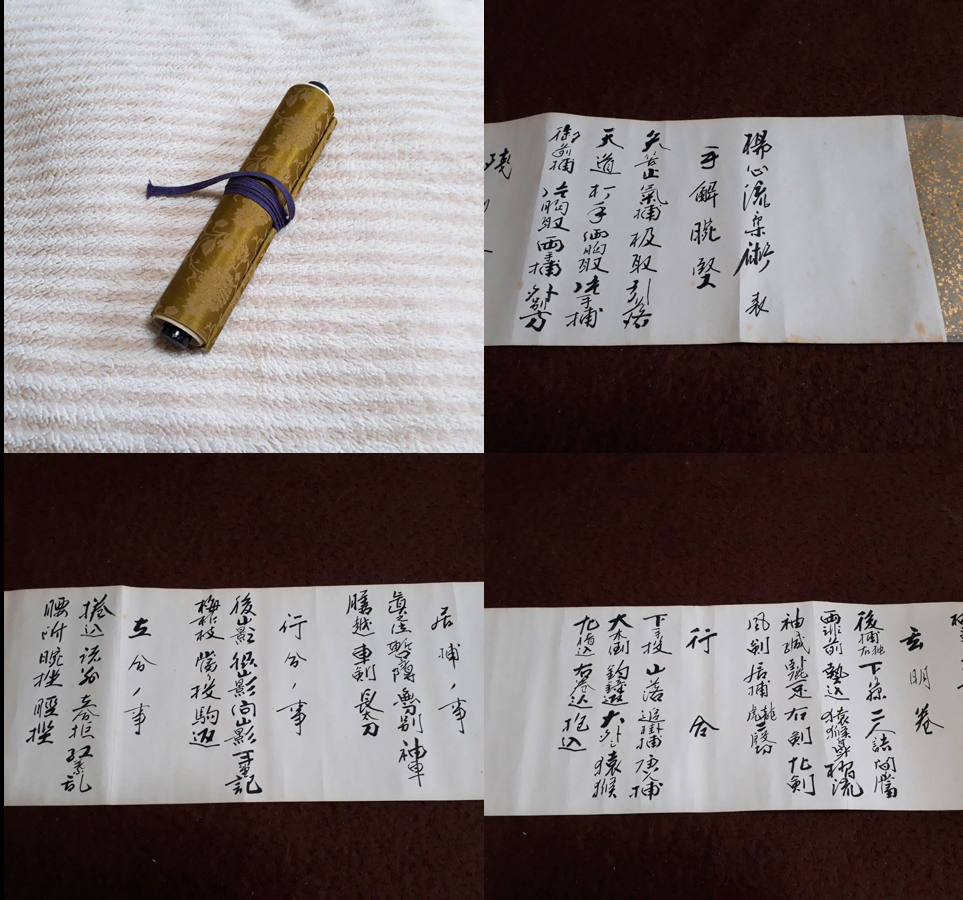
Below, I have included some pictures from the:
Yōshin-ryū Jūjutsu omote te kai ude ken makimono (楊心流柔術 表 手解 腕堅 巻物)
which, I recently obtained.
表 omote - surface
手 te - hand / arm
解 kai - solutiom / unravel
腕 ude - arm
堅 ken - hard/ strict / tough / solid
巻物 makimono - scroll


