
Ryōi Shintōkai
良移心当会
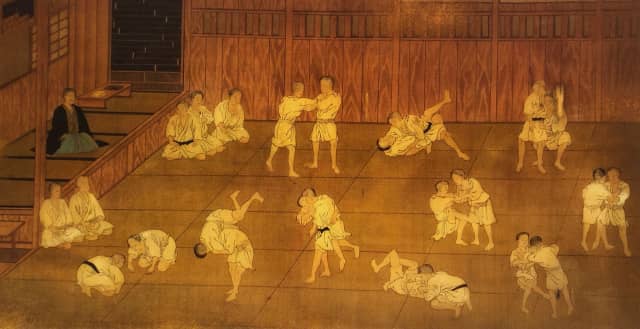
The randori of Ryōi Shintō-ryū Jūjutsu
It is interesting that Shinohara describes the randori of Ryōi Shintō-ryū Jūjutsu (良移心当流 柔術) as including body-striking and stomping techniques.
In Ryōi Shintō-ryū 'randori' is written 乱捕 (random, chaos or war - capture) and in Jūdō it is written 乱取 (random, chaos or war - take or fetch). In essence 'war, or chaos capture' is probably more descriptive of the Ryōi Shintō-ryū and 'random take' for that of Jūdō.
The Tsuki no Shō (月之抄) written by Yagyū Jūbei Mitsuyoshi (1642)
refers to the Kitō-ryū ran mokuroku (起倒流乱目録) suggesting that 'Ran' (乱chaos) may also have been a pivotal for that school.
Further to my post of 7th November 2019, regarding the match between Nakamura Hansuke (Ryōi Shintō-ryū Jūjutsu) of the Police Department and Yokoyama Sakujirō of the Kōdōkan (Jūdō) in Meiji 20 (1887, sometimes dated as 1886).
Shinohara (2005) describes how "they fought based on the rules of the Kōdōkan", and that after 55 minutes of fighting neither man could prevail and that the match was declared a draw.
As it was a draw, Nakamura was declared champion of East of Japan and Yokoyama champion of the West of Japan.
Shinohara goes on to state that:
“If the match had been carried out according to Ryōi Shintō-ryū martial-arts regulations, it is assumed that it would have been decided instantly,
In short, this proves that the randori of Ryōi Shintō RRyōi Shintō Ryū martial-arts regulations is in no way inferior to the randori that the new Kōdōkan Jūdō specialised in."
He later clarifies his above comments in a note stating that:
The Ryōi Shintō-ryū regulations would have allowed “….the use of body-striking techniques and stomping techniques."


