
Ryōi Shintōkai
良移心当会
Meiji era Ryōi Shintō-ryū champion - Nakamura Hansuke's matches against the Takeuchi Santō-ryū
Meiji era Ryōi Shintō-ryū (良移心当流) Jūjutsu champion, Nakamura Hansuke (中村半助) was born on 16th November 1846, in Kushihara Town, Kurume domain (now Fukuoka Prefecture) on the Southern Island of Kyushu, Japan
From a young age, Nakamura learned Ryōi Shintō-ryū Jūjutsu at the Shimosaka Saizō dōjō (下坂才蔵の道場) in Kushihara.
During his career, Nakamura fought several matches against the exponents of the Takeuchi Santō-ryū (竹内三統流) Jūjutsu school (an off-shoot of the Takenouchi-ryū) and those matches are the subject of this short post.
In 1869, at the age of 24 years of age, Nakamura was beaten in a match by Samura Masaaki (佐村正明).
Regarding Samura Masaaki, his son Samura Kaichiro (佐村嘉一郎) eventually become a 10th Dan (十段) in Kōdōkan Jūdō (講道館 柔道) in 1948. In a biography of Kaichiro on the Kōdōkan’s website, it states that father Samura Masaaki was a Menkyo Kaiden (Full licence of transmission) holder of Takeuchi Santō-ryū and that he had a fearsome reputation as a Jūjutsuka in Kumamoto Domain (also on Island of Kyushu), where he was known ‘Niō no Samura' (仁王の佐村 – Samura the Deva king / one of the guardian gods of Buddhism).
Prior to his match with Samura, Nakamura gave himself the nickname of ‘Kouhei no Hansuke’ (鍾馗の半助 – Hansuke the vanquisher of ghosts and evil beings) in response to Samura’s nickname of ‘Niō no Samura' (see above)
In the spring of 1881 (Meiji 14), Nakamura went on an expedition to Kumamoto together with his fellow Ryōi Shintō-ryū colleagues: Utaka Gyoyu, Uehara Shogo , Senoo Kishinoshin , and Noda Ichiro . There he participated in another challenge match between the Ryōi Shintō-ryū and Takeuchi Santo-ryū.
This time he faced Yano Koji. Unlike the previous match, Nakamura dominated, pinning Yano with 'kami shiho gatame' (上四方固 – upper four quarters hold). However, Yano cheated by biting Nakamura’s in the chest. Against Nakamura's wishes, the match was stopped by Samura, who considered his teammate's act as dishonourable and broke Yano's teeth with his wooden chopsticks to make him release his bite.
In 1887 (Meiji 20), both Nakamura Masaaki Samura were both part of the Tokyo Police Jūjutsu Instructor’s group, when they had a rematch at the Metropolitan Police Department of Marunouchi Blacksmith Bridge and on this ocassion Nakamura won.
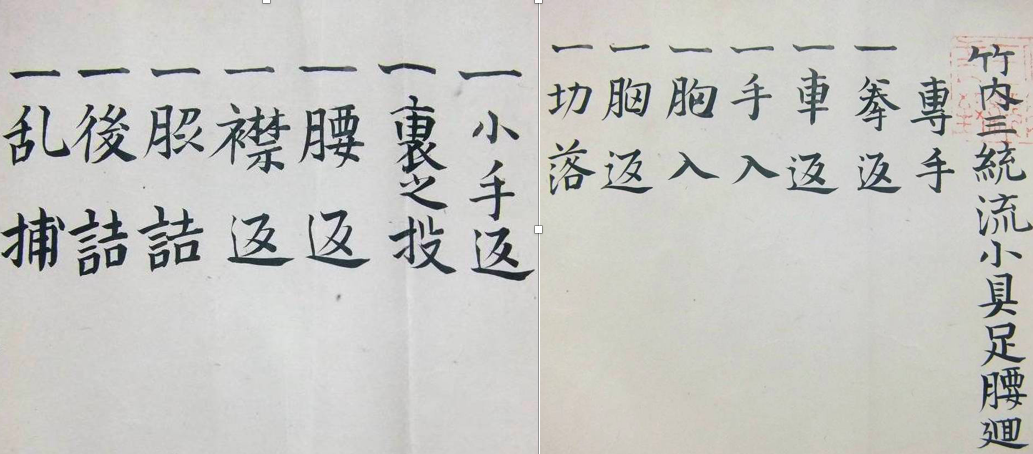
The initial section of the Takeuchi Santō-ryū Kogusoku Koshimawari (竹内三統流 小具足腰廻) makimono (scroll) below is from my personal collection. it is signed by Yano Koji (矢野廣次 - Yano Gonnosuke Hirotsugu), who was not only Nakamura's 1881 opponent, but according to Ellis Amdur & Lance Gatling (2016), also "consolidated and modified the extant lines of Takenouchi-ryu and Araki-ryu and named his consolidated system, Takeuchi Santo-ryu.".
The techniques listed in the pictures are:
専手 Sente (Initial Techniques)
一拳 返 Kobushi Gaeshi (Fist Counter)
一車 返 Kuruma Gaeshi (Wheel Counter)
一手 入 Te Iri (Trimming Hand)
一胸 入 Muna Iri (Entering At The Chest)
一胸 返 Muna Gaeshi (Chest Counter)
一切 落 Kiri Otoshi (Lopping Off)
一小手返 Kote Gaeshi (Wrist Counter)
一裏之投 Ura No Nage (Reversing Throw)
一腰 返 Koshi Gaeshi (Hip Counter)
一襟 返 Eri Gaeshi (Collar Counter)
一脇 詰 Waki Dzume (Stuffing To The Side)
一後 詰 Ushiro Dzume (Stuffing To The Rear)
一亂 捕 Ran Dori (Melee Capture)
(translation by Logan Weymouth)


