
Ryōi Shintōkai
良移心当会
Kumiuchi (組討) - (Part 1)
Kumiuchi (Part 1)Kumiuchi (組討 or 組打 - grappling) is a major component and a descriptor that has been regularly applied to the techniques and strategy approach of Ryōi Shintō-ryū throughout the majority of its 400 year history.
While we have a tendency view to Jūjutsu as a soft, or pliant art. However, Fukuno Shichirouemon (1622) wrote that:
“Revolving the ten million (infinite) schemes, consider the hard as the father and the weak (soft) as the mother.”
As In (yin) and Yō (yang) exist, so does goju (剛柔 – hard & soft). Kumiuchi challenges against resistance in ‘corps-a-corps’ grappling at a point where two opponents meet and clash.
This clashing is reflected in the Ryōi Shintō-ryū - ‘Mome ai hei undō’ (Clashing motion / moment) which traditionally forms part of the Menkyo Kaiden level transmission
In his book ‘Classical Fighting Arts of Japan: A Complete Guide to Koryu Jujutsu’ Serge Mol describes characteristics of Kumiuchi during different historical periods as follows:
Yoroi kumiuchi (鎧組討 - armoured grappling), primarily saw it’s expression during the ‘Sengoku period’ (戦国時代, Sengoku Jidai, i.e. Warring States period - from 1467 until the Siege of Osaka in 1615). However, it would have still been part of the practice of required of ‘Bushi’ (Samurai) during the later Edo period.
Heifuku Kumiuchi (平服組打 - ordinary clothes grappling), saw use during the Edo period (江戸時代, Edo Jidai, from 1603 to 1868) and this allowed for wider application of atemi jutsu (当身術 - striking) to attack vital points.
During the Meiji (1868 – 1912) and subsequent periods, Kumiuchi provided the foundation for both early contests and the subsequent development of Jūdō randori.
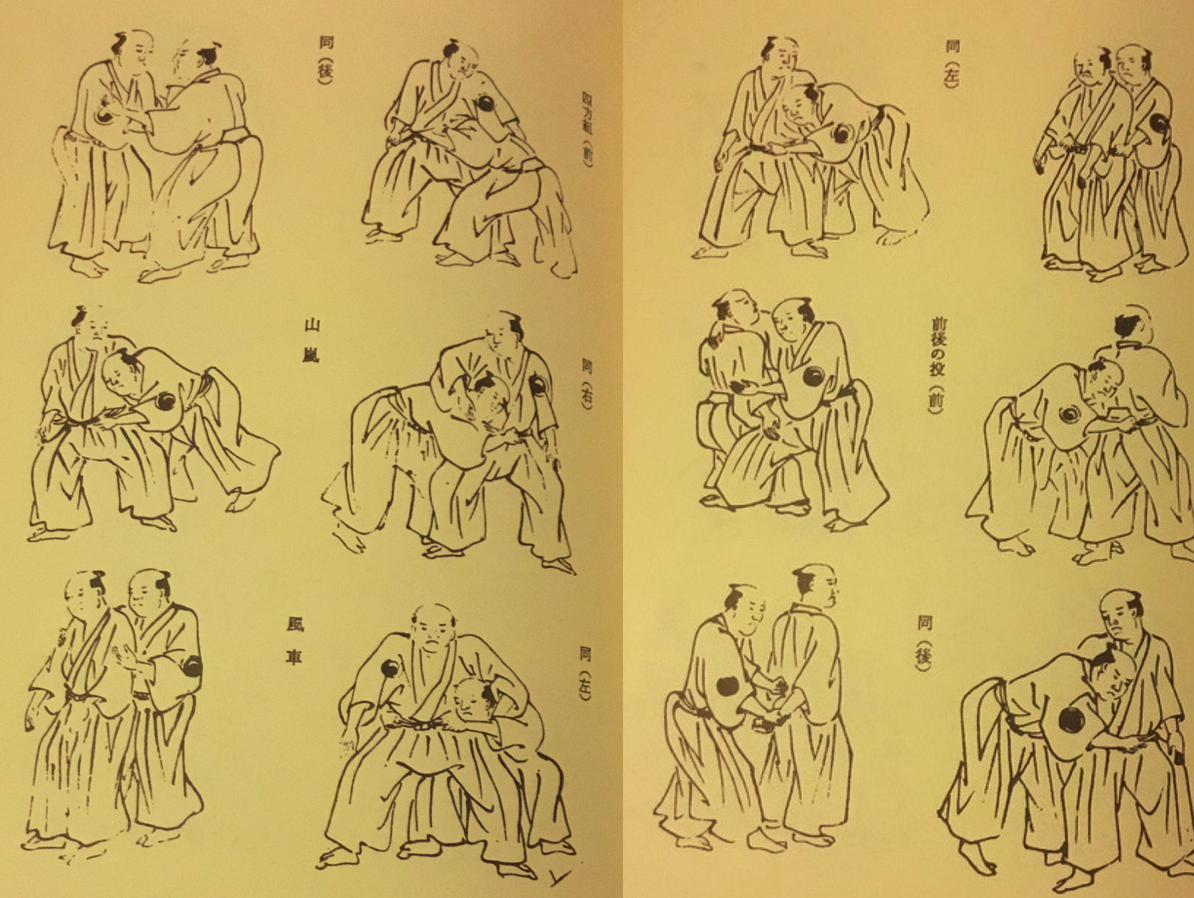
The accompanying pictures are of Sekiguchi-ryū (関口流) from the book:"Nihon Budō Taikei (日本武道大系 - Japanese Budō Compedium) Dairokukan (第六巻 - Volume 6)"
(See previous post on 8th December 2020 about the Ryōi Shintō-ryū - Miura-ryū, Sekiguchi-ryū & Shibukawa-ryū connection)


