
Ryōi Shintōkai
良移心当会
Buke Sumo (武家相撲 - Samurai Sumo)
Having read about Ryoi Shintō-ryū's founder - Fukuno Shichirouemon Masakatsu having been a ‘Meishu’ (名手 – master) of Sumo (相撲) and the school's early emphasis being on Kumiuchi (組討), I realised that I was missing something about sumo history.
On finding the Japanese language Wikipedia page on 'Buke Sumo (武家相撲 - Samurai Sumo), this all fell into place.
"…among the samurai who had established a feudal system in rural areas , sumo wrestling was routinely performed under the original purpose of daily training . Sumo movements were useful as training in close quarters combat, which was an effort to wear armour "
The article goes on to explain, that during the time of Tokugawa Ieyasu (Shōgun 1603-1616), the practice of Samurai Sumo ceased and sumo was primarily practiced as a wrestling sport.
See: https://ja.wikipedia.org/wiki/%E6%AD%A6%E5%AE%B6%E7%9B%B8%E6%92%B2
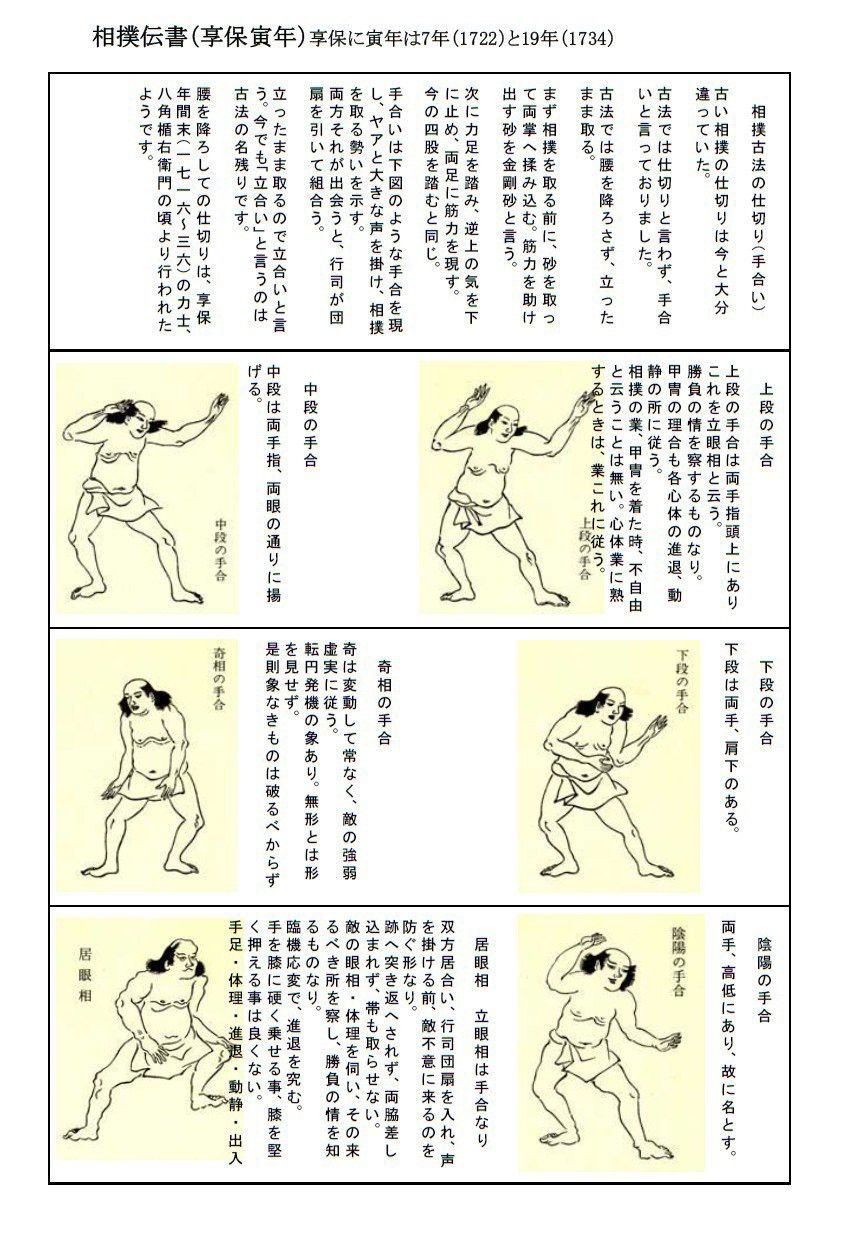
The accompanying illustration shows various sumo positions (Dated between 1722 & 1734): as follows
- 中段の手合 chūdan no teai (middle hand joining)
- 上段の手合 jōdan no teai (Upper hand joining)
- 奇相の手合 kisō no teai (strange phase)
- 下段の手合 gedan no teai (lower hand joining)
- I me-shō 居眼相 (Eye phase)
- Inyō no teai 陰陽の手合 (Yin Yang hand joining)


