
Ryōi Shintōkai
良移心当会
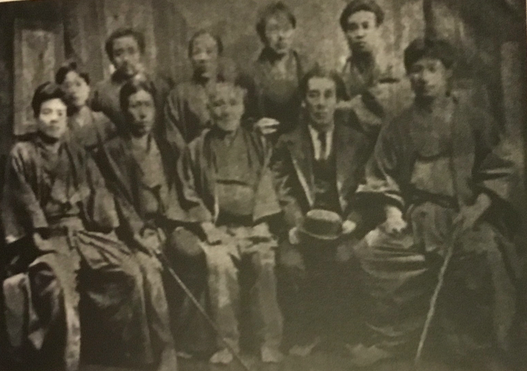
Totsuka-ha Yoshin-ryū (戸塚派揚心流)
Dr Erwin Bälz (1849 - 1913) was a German internist, anthropologist and personal physician to the Japanese Imperial Family. He taught at the Medical College of Tokyo Imperial University and was the co-founder of modern western medicine in Japan.
He provides a first hand account of the Totsuka-ha Yoshin-ryū (戸塚派揚心流) and during his time, it’s superiority over the Kōdōkan (講道館).
Ryōi Shintō-ryū Jūjutsu (良移心當流 柔術) Champion Nakamura Hansuke (中村 半助) fought alongside the Totsuka-ha Yoshin-ryū during a competition against the Kōdōkan (circa 1886).
Bälz writes:
“It was at about the same date that I first made acquaintance with jiujitsu. This was when I was visiting the provincial capital of Chiba. Talking to the governor about modern education, I complained how little interest in sport of any kind was shown by well-to-do youths of the upper classes, though their health was poor, and vigorous exercise would do them a lot of good. The governor was quite of my way of thinking, and expressed his strong regret that jiujitsu, as a splendid method of physical training formerly much practiced in Japan, should have gone so completely out of use. It was, in fact, still practiced in his own town, where an old teacher of the art, Totsuka by name, instructed the police in it. The results had been marvelous, and his men found it of the greatest value in making arrests. Next day he asked me to attend a gathering where Totsuka, a man over seventy years of age, gave a demonstration of the principles of jiujitsu and showed the various grips. Then I watched dozens of jiujitsu contests, and was extremely impressed with the results. I saw what I should have expected to be neck-breaking trips and movements and throws executed without causing the least injury to the contestants; and I said to myself that this would be an ideal form of gymnastics for my students.
Still I had no success with the matter in Tokyo. The director of the medical school and the other leading Japanese at the university and in the Ministry for Education would not hear a word of my proposal to summon the jiujitsu expert from Chiba to give a demonstration in Tokyo. The students, they said, had come to the university to do mental work. There had been some sense in jiujitsu in the old days, when people had to protect themselves against armed men, but that was all over now. My insistence that I was concerned only with jiujitsu as a means of bodily training, as a matter of health, had no effect. Then it occurred to me to do what I had done in the case of the Japanese sword-fencing and to arouse interest by studying jiujitsu for myself. Unfortunately, I could not find any teacher willing to accept me as a pupil, for they all said that it is necessary to begin in boyhood, and that I, being thirty, might easily do myself serious harm.
Meanwhile, however, some of the students and ex-students of the university had taken up jiujitsu. The young professor Kano was especially active in the matter, and to him the renewed popularization of the old sport is especially due. He and his comrades were at length successful in inducing the university authorities to summon the jiujitsu expert from Chiba and a great jiujitsu contest took place. This made it clear how much training is needed to learn the art, for all the young men who had been working at it in Tokyo, no one, not even Kano, could cope with the police officers who had been trained by Totsuka in Chiba.
Next day old Totsuka, accompanied by his best pupil Sato, came to call on me and to thank me for my exertions in the matter. I can still see him in imagination, this venerable old man, as, with tears running down his cheeks, he begged me for my photograph that he said he would treasure to the end of his life. As a Japanese, he declared, it made him blush that a foreigner should have had to tell his fellow countrymen that it was incumbent upon them to revive jiujitsu; but now, when he knew that his beloved art would come into honour once more, he could die in peace.”
The above photo is of a Totsuka-ha Yoshin-ryū (戸塚派揚心流) group. It shows Totsuka-ha Yoshin-ryu ninth headmaster Totsuka Hidetoshi seated centre. Tenth headmaster, Totsuka Hideyoshi is seated to his left. Taken from ‘Shindo Yoshin Ryu, History and Technique.’ by Tobin Threadgill and Shingo Ohgami (2020).


