
Ryōi Shintōkai
良移心当会
Does the Kuzushi (崩し - balance breaking) of Kōdōkan Jūdō (講道館 柔道) originate from Ryōi Shintō-ryū Jūjutsu (良移心当流 柔術) ?
Carl De Crée's (2014) article states the following:
“Kitō-ryū delivered most of Kanō’s inspiration for throws and for his concept of Jū yoku gō o sei suru 柔能く剛を精する (Non‐resistance overcomes force), although the latter can be traced even further towards the roots of historic sumō 相撲 wrestling (De Crée, 2014; Kanō, 2006). More specifically, Kanō also obtained his concept of kuzushi or “breaking balance” from Kitō-ryū jūjutsu, where it is dealt with in the traditional makimono 巻物 (scroll) Hontai no maki 本體之巻 (Scroll of Proper Body Position) and Chi no maki 地之巻 (Scroll of the Earth)”
Firstly, it is well known that Kitō-ryū derived from Ryōi Shintō-ryū.
Secondly, De Crée specifically mentions the Hontai no maki (本體之巻) and the Chi no maki (地之巻) documents from Kitō-ryū.
The Hontai no maki shows Fukuno Shichirouemon Yuzen (福野七郎右衛門友善) - who was the founder of Ryōi Shintō-ryū, as being the 'Shoryū Kaiso' (諸流 開祖-various streams founder).
In the 'Kitō-ryū Kiroku' (Translated by Logan Weymouth - 2019) it states that:
"In the Chi and Jin no maki Books of Earth and Man, Sensei Fukuno's full name appears first such as in the drawn up Keizu lineage listings."
As Hontai and the Chi no maki documents can be traced to Fukuno, who was the founder of Ryōi Shintō-ryū and as De Crée states these same documents are the basis of the principle of Kuzushi within Kōdōkan Jūdō, then is is reasonable to assert that the Kuzushi of Jūdō finds its origins in Ryōi Shintō-ryū Jūjutsu.
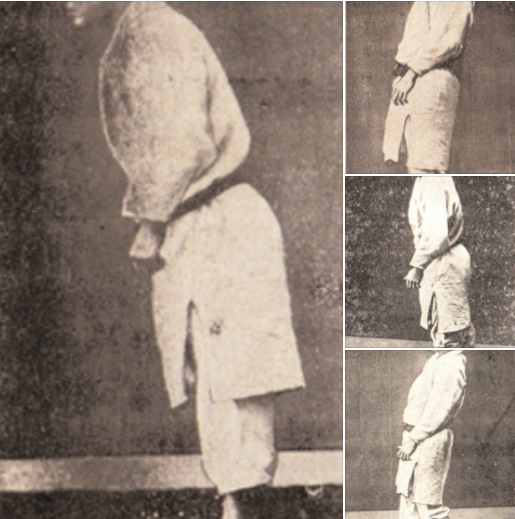
The pictures above show the various directions of balance breaking from Yokoyama Sakujiro & Oshima Eisuke's (1915) book - 'Judo Kyohan'.


