
Ryōi Shintōkai
良移心当会
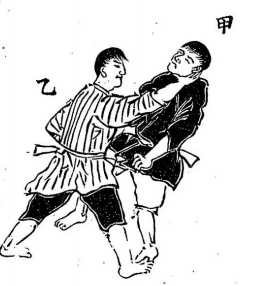
Randori 乱取 in the context of old (Ko-ryū 古流) Jūjutsu
I was interested to read in Eric Shahan’s translation of various mokuroku in his excellent book: ‘A Collection of Curious Jujutsu Manuals’ (2018). Included within this is a work written by Kimura Sentaro (written in 1907) concerning the Shingen Shinto ryu. This is described as being a derivation of the Yagyū-ryū and the Shinto-ryū . Whether is the same, or not is difficult to know for certain, but Shinto-ryū (in various kanji spellings) was a name used by the Nagahama branch of the Ryōi Shintō-ryū.
Kimura describes the relationship between Kata and Randori as follows
“There are two types of Jūjutsu, Kata and Randori. The purpose of Kata training is to strengthen the body and equip it with the ability to use Sakkatsu, points on the body that can either kill or revive a person depending on your goal.
Randori on the other hand, was said to have been developed long ago on the battlefield. It was used to take down and control Samurai in armour. Initially, Randori training would be done within the confines of Kata. These days there are a great many demonstrations of martial arts, and most people are probably familiar with them. The people demonstrating have train intensively in Kata and now are able to use Shikkatsu, or techniques that can deliver life or death, freely and without impediment.
However, during these demonstrations Randori is never shown. The simple fact is that in in free sparring the limbs of the body will not conform to a prescribed set of movements with a predetermined outcome. This will not result in a clear demonstration. Therefore for the benefit of those viewing, martial arts demonstrations are a combination of Kata and Randori. It is a kind of pre-determined free-sparring. This combination training has to be done in order to demonstrate what Randori is.
Training in this fashion will strengthen the core of the body allowing you to execute Sakkatsu on those seeking to do violence to you. Those already doing martial arts training or are on the martial path need not be reminded of this, but readers should learn what they can from the following pages, especially the admonition at the end.”
Note
Kata - in martial arts, a set of prescribed movements, strikes and kicks, either offensive or defensive. A pattern.
Randori - Free sparring
Atari-mi. - Another way to read the more common Atemi. Striking points. Later in this book it is also read as Toshin.
Sakketsu - Points on the body that are targets during combat todo maximum damage but can also be used to resuscitate victims.
Shikatsu - A term that means the same as Sakkatsu, but replaces the first Kanji “death” instead of “kill”


